When God Commands Violence: Wrestling with the Old Testament’s Hardest Question
One of the most persistent challenges for thoughtful Christians is this: if God is love, why does the Old Testament record him commanding, even orchestrating, violence against entire peoples? And if he is willing to relent for Nineveh, why not for the Philistines, the Amalekites, or the Canaanites? Isn’t that favoritism?
Violence as Judgment, Not Caprice
The biblical text itself frames the conquest narratives not as ethnic cleansing but as judgment on specific practices: child sacrifice, systemic injustice, and entrenched idolatry tied to real social harm. Deuteronomy is explicit: “It is not because of your righteousness… that the Lord your God is giving you this land to possess, but because of the wickedness of these nations” (Deuteronomy 9:4 to 5). Whatever discomfort remains, the text insists this is God’s Judgment over these nations.
Scholars like Paul Copan also argue that much of the “total destruction” language, known as herem, reflects standard Ancient Near Eastern war rhetoric. The same hyperbolic idioms appear in Egyptian and Assyrian royal inscriptions. Tellingly, the biblical text itself later mentions these same peoples still living in the land, suggesting the language was not meant as literal genocide reporting but as a conventional way of describing decisive victory.
The Nineveh Problem
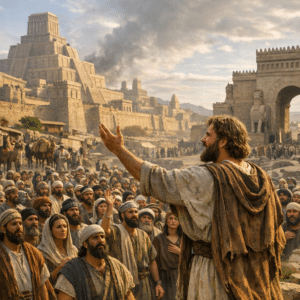
This is where the question cuts deepest. Jonah’s Nineveh gets a prophet, a warning, and a second chance. The Philistines do not get a recorded Jonah. Is that not favoritism?
Paul offers a partial answer in Romans 1 to 2 and Acts 17:26 to 27: no nation was left entirely without witness. Creation itself, and conscience, function as a kind of universal testimony. But let’s be honest, this does not fully dissolve the tension. Scripture does not claim to be an exhaustive record of how God dealt with every nation on earth; it tells salvation history from Israel’s vantage point. What we do not see is not necessarily what did not happen.
Still, intellectual honesty requires admitting that the Bible does not hand us a clean resolution here. It is a real theological difficulty, not a puzzle with a tidy answer, and theologians from Origen to Greg Boyd have wrestled hard with exactly this asymmetry.
Why Did the Violence Stop?

Jesus does not introduce the command “you shall not murder”; it is already in Exodus 20. What he does is radicalize it (Matthew 5:21 to 22, where even anger is culpable) and, more significantly, relocate the battlefield. “We do not wage war against flesh and blood” (Ephesians 6:12). The enemy is no longer a territorial rival but sin, death, and Demons, defeated not by conquest but by the cross (Colossians 2:15).
Conclusion: A Non Resolution, and That’s Okay
As Christians, it is also important to reflect on topics like this. We should remind ourselves that if we are not able to discuss such things, it may mean our faith isn’t as strong as it could be. Sometimes it’s important to be sincere and admit that we don’t have all the answers, and that’s okay.
I have always been the kind of person who wants to understand every detail. Yet I feel that God, knowing humans are made this way, chose to leave some questions unanswered for us. Otherwise, faith wouldn’t be necessary. Perhaps in eternity, God will give us answers to these questions. Who knows?
When facing topics like this, I always prefer to hold on to this truth: even though I don’t understand it, I know God is good. So even when I don’t understand everything, I can rely on His goodness. This is my invitation to you today as well.
Enjoyed this article? Continue your spiritual growth by reading our next article: